Staff archetypes
it’s also worth remembering that over your thirty or forty-year career, you’ll have long enough to spend some time sampling every archetype.
What Silicon Valley “Gets” about Software Engineers that Traditional Companies Do Not
In contrast, traditional companies often make it impossible for developers to interact with the rest of the business. This is not how it’s presented, though. They’ll say “we want to shield our engineers from distraction”. But I’ve heard stories of an engineering manager wanting to invite team members to a product presentation, and the product manager shutting this idea down. “We need them to work, and we can’t afford to be distracted.” is a common excuse.
When an engineer at a traditional company builds relationships outside their team, they’ll often get told they are “not focusing enough”, “wasting time” or doing things that is “not their business”. This kind of “unusual” activity would often be recorded as a negative in their performance review.
Profit Centers vs Cost Centers at Tech Companies
The Scoop #25: A chilly market continuing to cool
Booking.com shows how increasingly challenging it is for global companies to navigate a growing number of sanctions.
What does Amazon slowing hiring down really mean? I mean beyond the obvious: that they expect to have demand go up far less in 2023 than what they have seen in 2021.
The driving factor of AWS revenue is the global GDP.
It’s safe to assume that this statement is true not just for AWS but also for Amazon, as a whole. So Amazon slowing down hiring could well be an indicator that the global economy is expected to slow in growth.
What’s the implication on hiring (besides the slowing down HC allocation)? Especially about the pay bands?
Hybrid Work Is Just Work. Are We Doing It Wrong?
Leaders need to create clarity and purpose for their people, aligning work with the company mission and team goals. And defining what work doesn’t matter is just as important as defining what does—in a world where everything is important, nothing is.
The data shows that people come in for each other to recapture what they miss: the social connection of being with other people. In other words: rebuilding social capital can be a powerful lever for bringing people back to the office.
How Big Tech Runs Tech Projects and the Curious Absence of Scrum
Project management is a piece in a complex and ever-changing puzzle. However, it is not – and should not be – an end goal, only an enabler to reach that goal quicker.
Methodologies used by companies in this survey were:
No “formal” methodology: common for public and venture-funded tech companies.
Plan, build, ship: common for public and venture-funded tech companies.
Scrum: common for large, non-tech companies, non-venture funded companies and consultancies.
Kanban: mentioned across all companies.
SAFe (Scaled Agile Framework): mentioned with large, non tech companies and a non-venture funded company.
Shape Up: mentioned for a few venture-funded companies.
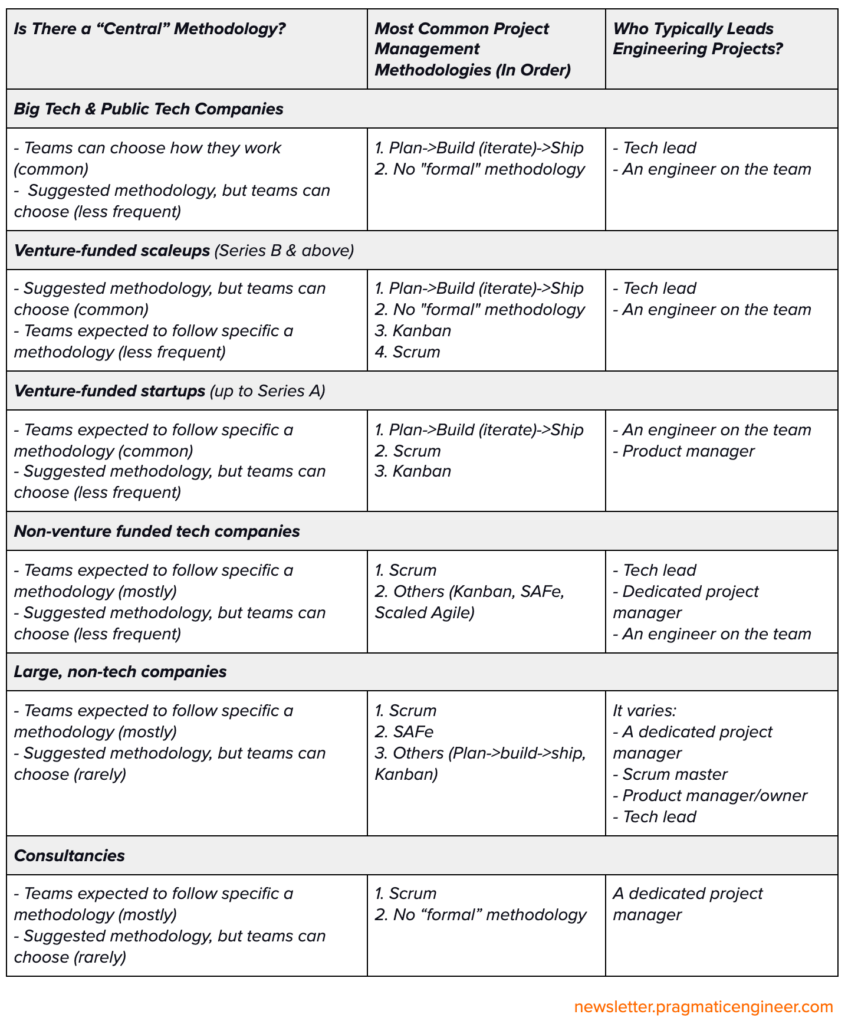
Turns out Scrum is not the “Golden” method and the largest organizations have ruled it out.
Scrum v.s. Plan->build->ship?
What’s the drawbacks of scum? (I can see Scrum can be a force of stopping engineers from getting more product insights, making engineers more like factory workers)
Team autonomy and high satisfaction seemed to be correlated.
Teams struggling often had little to do with the methodologies.
JIRA has been mentioned mostly with negative associations.
Requirements changing, even with dedicated project managers, sits poorly with engineers. While there are teams where requirements change a lot, on these teams it’s typically the engineers who run the projects, and can deal with them. However, when a dedicated project manager is unable to shield the team from requirements changing, respondents rated this approach as poor.
Responsibility of project lead scales with the project complexity. For simpler projects, an engineer can take the project lead role; For complex projects, an TPM takes the project lead role. The breakeven point is the job of leading certain project is heavy enough to be made a full-time job.
Whoever leads the project has the advantage of building relationships with other engineers on the same project, as well as building communication & leadership muscles. Therefore it’s usually better leaving the project leading responsibilties to the engineering team, as long as the complexity allows.
Scrum adds heavy ritual burden to the team.
Competent, autonomous people need less structure to produce reliable, high-quality output.
Repaying tech and architecture debt. All of Big Tech moves fast and responds to new opportunities quickly. In doing so, companies often take shortcuts that result in tech and architecture debt. How can repaying this debt in a sensible way be part of the everyday process, instead of having “big bang” tech debt payoff projects?
Slack time for innovation and unexpected work. For teams that are expected to innovate, how do you create slack time to make this happen?
“Kitchen sink teams” which have everything thrown at them, can make use of scrum, which gives space for the team to ignore external interruptions (from various stakeholders).
Spark in App Annie was more like a kitchen sink team than an autonomous team because the team’s lack of product vision impaired it from delivering impactful innovations. Other causes:
- The manager failed to keep the team anotomous and empowered and stay separated from the rest of the company.
- The product managers assigned to the team failed to define high-level priorities to the team. Instead, they delivered direct product ideas that was not feasible to achieve without been signed off by higher level executives.
Directing, mentoring and coaching all have their uses.